
Is Iran's nuclear program destroyed or not?
The true value of the stunning campaign against Iran’s nuclear facilities lies not in the results of any specific damage assessment but in the now, fully open skies above Iran.

The head of France’s DGSE intelligence agency, Nicolas Lerner, announced yesterday that Israel and the United States had overstated the impact of their strikes on Iran, claiming the nuclear program has been set back by only “a few months.” By contrast, U.S. President Donald Trump has used terms like “total obliteration,” while Israeli Prime Minister Benjamin Netanyahu described the results as a “historic victory.” These are just a few of the conflicting voices regarding the success (or lack thereof) of Israel and America’s campaign to destroy Iran’s nuclear capacity.
So which is it? The answer: neither.
Almost everything we think we know is now irrelevant, and to understand the new reality requires an entirely new world view.
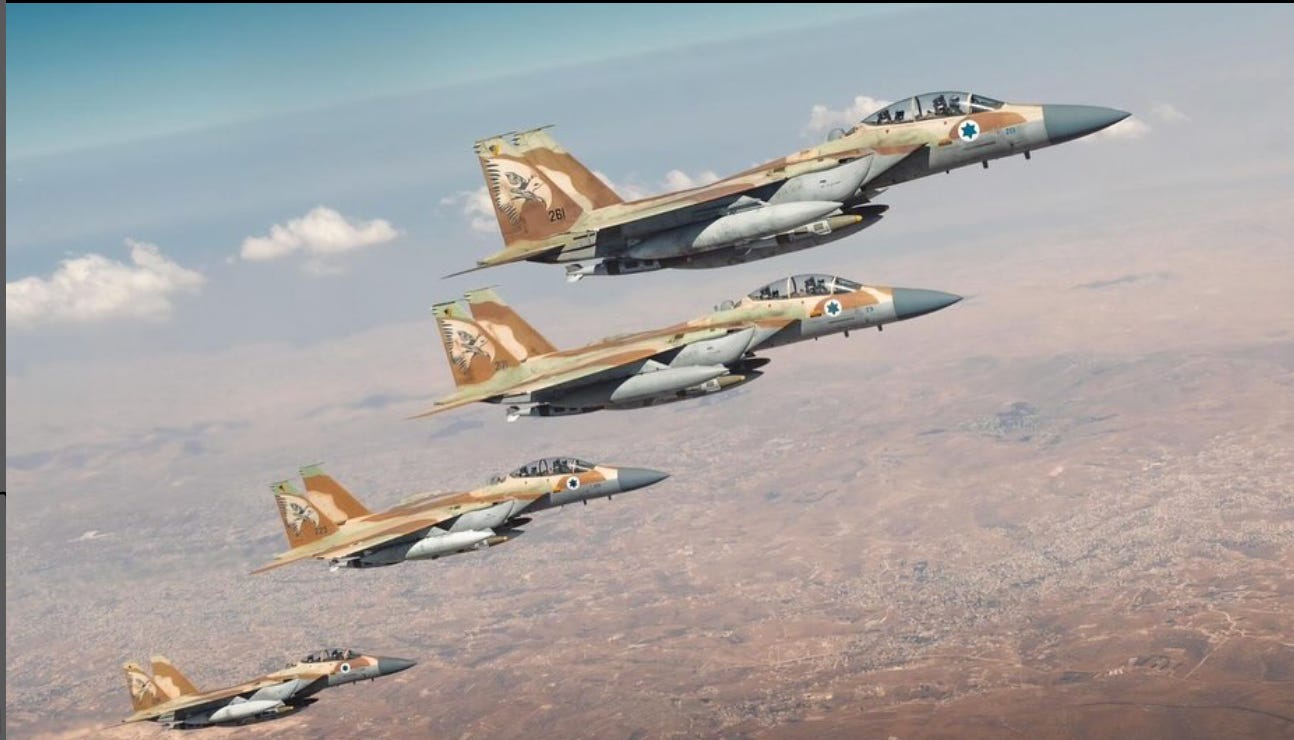
Photo: Israeli fighter jets on the way to Iran, June 2025. By: IDF
PDA/BDA assessments take months.
The whole assessment concept is part of the old world view, but let’s address it anyway, and then talk about why it’s irrelevant.
A truly accurate PDA (Physical Damage Assessment) or BDA (Bomb Damage Assessment) takes weeks to months to complete. America’s Joint Chiefs of Staff’s “Methodology for Combat Assessment” describes PDA as taking place in three phases, each involving multiple intelligence sources. Truly reliable results become available only after completing Phase III, which historically has taken months to complete, such as after bombing campaigns in Kosovo as well as Iraq and Afghanistan.
In short, anyone talking at this stage is, at best, communicating an unreliable Phase I or II assessment, or at worst, is merely spouting agenda driven PR.
Trump and Netanyahu are probably right.
Again, this doesn’t really matter, but let’s explore it anyway.
Despite the limitations of PDA/BDA assessment methods, logic dictates that Trump and Netanyahu’s assessments of “total obliteration” and “historic victory” are probably correct, based on these three realities:
Most of the bombs dropped on Iran have guidance systems which means they will consistently land exactly on target. Accuracy is measured by what’s called a “CEP” (Circular Error Probable) which ranges from 1 meter (about 3 feet) for certain smaller laser guided munitions, to 5 meters (about 20 feet) for the massive GBU-57 bombs which the United States dropped on Iran’s Fordo facility.
As far as we know, Israel has superb intelligence on Iranian facilities, including their size, shape and composition, their depth, what type of geology surrounds them, and every other relevant factor.
The United States and Israel employ plenty of experts in physics and mathematics. Dropping a known munition with high accuracy on a known target will produce scientifically predictable results.
Assuming all three of these assertions are true, it is highly likely that the Israeli and American bombing campaigns accomplished exactly what they intended. It is of course possible that there were some unknowns or surprises underground: for example, an unexpected change to the structure or a different geology than originally thought. For this reason we will not know the results for certain until after the Phase III assessments are completed.
However, none of that matters because…
This situation is not static, but dynamic.
This whole phrasing of how many months or years Iran’s nuclear program was “set back” is, in truth, utterly meaningless.
In order to know how far I am from a goal, I must know two things: where I am located in relation to that goal, and also how quickly I’m traveling. For example, if I want to get from Tel Aviv to New York, I must cover about 6,000 miles. By airplane that will take about 12 hours, by ship it will take several weeks, and if I sit on my couch and don’t move, then I will never arrive in New York at all.
We have some sense of where Iran’s facilities and resources stand in relation to the goal of producing a nuclear weapon, but how fast is Iran moving toward that goal?
Put aside for a moment that most of Iran’s nuclear scientists were killed in Israeli strikes, and that any remaining scientists are probably rethinking their career choices right now. There is also a deeper reality, one that has changed the Middle East: Israel and the United States now command total air superiority over Iranian skies and impressive intelligence penetration into Iran’s military operations.
Previously, in order to slow Iran’s progress toward a nuclear weapon, the world was limited to U.N. inspections, subtle acts of sabotage or assassination, and negotiations. Yet now, with Iran’s proxy network in ruins, its air defenses laid waste, and its ballistic missile network degraded, we are living in a whole new world: one in which Israel or America can fly into Iran at any time and destroy pretty much anything they choose, even if it’s hidden hundreds of feet underneath a mountain.
So we return to the original question: at what pace is Iran moving toward a nuclear bomb? The answer is: it doesn’t matter, because any progress Iran makes can be promptly destroyed. Iran is, metaphorically speaking, like a traveller without a passport: he can go to the airport, but will never be allowed to travel.
China is rumored to be already resupplying Iran’s ballistic missile capacity (a rumor which China denies) and Iran has removed the International Atomic Energy Agency inspectors from the remains of its nuclear sites: a possible precursor to resuming illicit activities.
None of this matters if the world stays vigilant.
The true value of Israel’s stunning campaign against Iran’s nuclear facilities, and America’s impressive conclusion, lies not in the results of any specific damage assessment but in the now, fully open, skies over Iran. The free world has a new capacity to stop any future threats, but a change in Western politics or popular opinion could upend these hard won gains.
If Israel, America and the entire free world remain both vigilant and active, then the potential for Iran, the Middle East and the entire world, is bright and unbounded by any deadline. Yet we will be safe only so long as we live up to our responsibility to protect that very safety.
Your column is an accurate assessment of the situation. It is dynamic and Iran needs to be constantly monitored and assessed. What is known is that Israel owned the skies over Iran; the U.S.A. came to Israel's assistance in a big way that was both tactical and strategic; America and Israel's bombing of known Iranian nuclear weapon development facilities didn't help accelerate Iran's development of a nuclear weapon; Iran has the ability to launch multiple missiles and drones at Israel and cause death and destruction, requiring Israel to further develop and refine its defensive capabilities.
Total air superiority over Iran rewrites the rules. The bomb is no longer the bottleneck; deterrence is. If we stay vigilant, the skies stay open. But vigilance fades fast in democracies. This is something I'm exploring in my own writings as well.